Amazon advertising: what you steer on
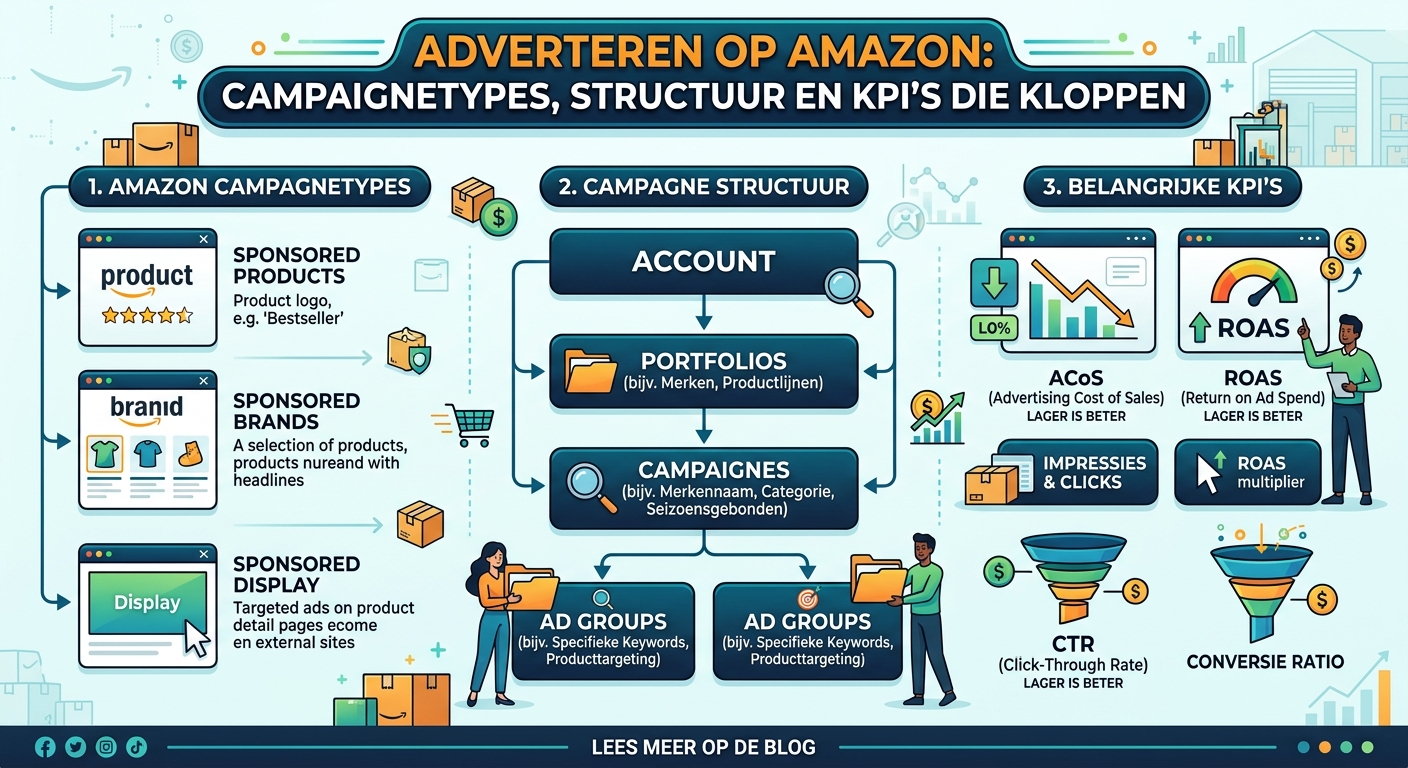
Amazon advertising runs on three main types: Sponsored Products (individual products in search results), Sponsored Brands (brand placements with logo and multiple products) and Sponsored Display (retargeting on and off Amazon). You steer on ACOS (ad spend divided by ad revenue) and TACOS (ad spend divided by total revenue). Without margin per product, any ACOS target is a guess.
The three campaign types
Sponsored Products. The foundation, and 70 to 90% of budget for most sellers. Cost per click, targeted at search terms or at products. This is where new listings earn their first sales.
Sponsored Brands. Brand registry only. Above the search results, with logo and several products or a video. Strong for brand building and defending your own brand name; less directly profitable on last click.
Sponsored Display. Retargeting visitors and targeting competitor product pages. Useful as an addition, rarely as a starting point.
Automatic and manual: use both
Automatic campaigns let Amazon decide which search terms you appear on. That isn't laziness, it's data collection — you discover terms you'd never have written down.
The cycle that works:
Start an automatic campaign on a modest budget.
After two to four weeks, analyse which search terms actually convert.
Move those terms into a manual campaign on exact match.
Add the non-converting terms as negatives in the automatic campaign.
Repeat.
That cycle is the whole discipline. The rest is refinement.
A structure you can maintain
Campaign | Purpose | Bidding |
|---|---|---|
Auto — discovery | Find search terms | Low bid, small budget |
Manual — exact, converting | Make profit | Bid based on break-even |
Manual — phrase, scaling | Grow | Moderate bid |
Brand defence | Protect your own name | Low bid, high relevance |
Creating more campaigns than you can review weekly is the most common mistake. Four campaigns you maintain beat twenty you open once a quarter.
Calculate your own ACOS target
A "good ACOS" doesn't exist in the abstract — only relative to your margin.
Break-even ACOS = contribution margin per unit ÷ sale price.
Sale price €29.95, contribution margin after referral fee, fulfilment and purchasing €8.76. Break-even ACOS = 29%. Advertise at 20% and you keep something. At 35% you're paying to make revenue. Build that calculation from the full fee breakdown.
Two nuances: during a launch you may sit above break-even, because you're buying sales history and organic position. Long term you steer on TACOS — falling TACOS at stable revenue means your organic share is growing, which is the actual goal.
Across marketplaces, cost per click has risen sharply in recent years; for many sellers ACOS roughly doubled year on year. Work with current figures, not a benchmark from a two-year-old guide.
Why advertising is rarely your real problem
An ad buys a click. What happens next decides whether you see the money back. At an 8% conversion rate you pay for 12.5 clicks per sale; at 12%, just over 8. That four-point difference on the product page moves your ACOS more than any bid change you'll make that month.
Before you raise budget, check your image gallery, your title and bullets — see Amazon listing optimisation — your price against comparable offers, your reviews, and your stock. Advertising a product that's out of stock is money thrown away. Want to refine further by time and day, see Amazon dayparting.
How Rylee sharpens advertising decisions
Ad platforms show your ACOS. They don't show your margin.
Contribution margin per product with your real costs, so you know your break-even ACOS per product instead of applying one average target.
Consolidated P&L across Amazon (all European marketplaces), bol, Kaufland, Shopify and WooCommerce — the total picture in which ad spend takes its real place.
AI Advisor to ask which products make margin, where costs rise and what changed versus last period.
AI Listing Designer for the conversion side: seven images per product from your own photos, with USP visuals and use cases, three revision rounds, five products a month free for customers. Better conversion lowers your ACOS without touching a single bid.
Scheduled reports and exports to check periodically whether ad spend still fits your margin.
Amazon Legends and Ecom Legends to work through campaign structures with other sellers.
Frequently asked questions
What's a good ACOS on Amazon? Anything below your break-even ACOS, which differs per product. At 30% contribution margin, 30% ACOS is your zero point, not your target.
Do I have to advertise a new listing? Almost always. A new ASIN has no sales history and gets little organic visibility.
What's the difference between ACOS and TACOS? ACOS compares ad spend to ad revenue. TACOS compares it to total revenue, showing how dependent you are on paid traffic.
How much budget do I need? Enough to collect several hundred clicks per campaign within two to four weeks. Below that you're measuring noise.