Amazon FBA: how the programme works
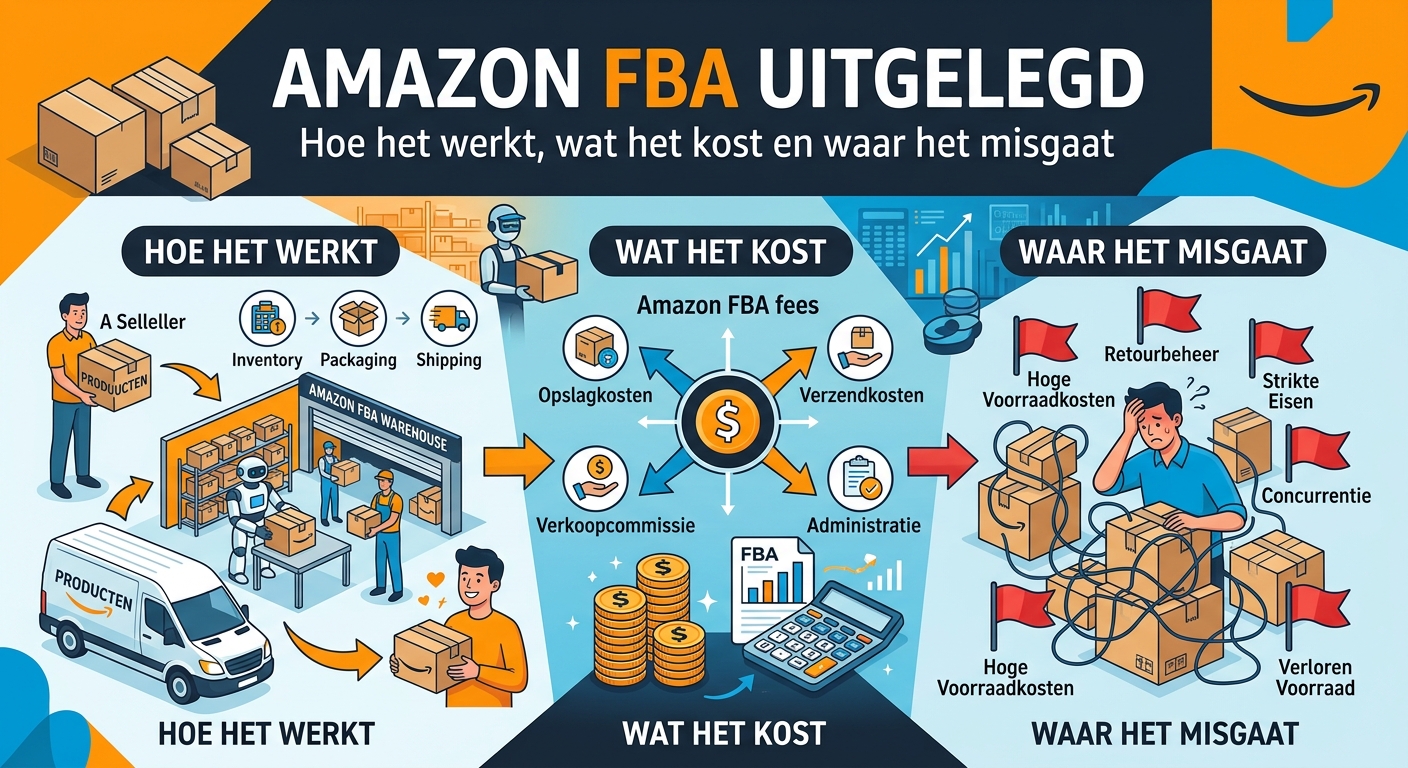
Amazon FBA (Fulfilment by Amazon) is the programme where you store stock in an Amazon fulfilment centre and Amazon handles picking, packing, shipping, returns and customer service. You pay a fulfilment fee per unit shipped plus monthly storage. Your products become Prime-eligible, which lifts visibility and conversion.
How the process runs
Enrol products for FBA in Seller Central, per product.
Create a shipment. Amazon determines which fulfilment centre you send to and generates the labels.
Prep and labelling. Products must meet packaging and labelling requirements; Amazon can do this for a fee.
Send inbound. Yourself, via a carrier, or through Amazon's carrier programme.
Receiving. Usually several days to over a week before your stock is sellable.
Sales and shipping. Amazon ships within the Prime promise.
Returns and customer service. Amazon handles it; returned items are assessed and, where possible, restocked as sellable.
What FBA costs
Fulfilment fee per unit, based on weight and dimensions. Standard-size and light is cheap; oversized or heavy escalates fast. A fuel and inflation surcharge of 1.5% applies to fulfilment fees from 17 April 2026, and reduced low-price rates were extended to items up to €20.
Storage per cubic metre per month, considerably higher in the fourth quarter, with additional charges for long-standing stock.
On top of that: return processing, removal or disposal fees and optional prep services. The full stack sits in Amazon seller fees.
What you get back
Prime. The main reason FBA works: Prime delivery lifts conversion on the same product page.
Scalability. Ten or a thousand orders a day costs you the same time.
Customer service and returns in the local language, across Europe.
Multi-country reach through EFN or Pan-EU without your own warehouses abroad.
VAT and Pan-EU: where it goes wrong
If your stock sits in one country and you sell to customers there, your local VAT number is enough. The moment stock is stored in another EU country — exactly what Pan-EU FBA does — you need a local VAT registration there. EFN (storage in one country, shipping across Europe) limits that to your storage country. Get the choice checked before you send inbound, not after.
Five mistakes that cost FBA sellers money
Sending too much stock. Storage and long-term storage fees eat your margin. Target 30 to 60 days.
Sending too little. Running out costs you selling position, and the way back is expensive.
Sending heavy, cheap products through FBA. Fulfilment fees scale with weight, not with your price.
Ignoring prep requirements. Wrongly labelled or packed shipments mean delays and extra charges.
Never recalculating. Amazon adjusts fees several times a year; last quarter's margin isn't this quarter's.
Which products belong in FBA at all is a per-product decision — see the scoring model in Amazon fulfilment options.
How Rylee supports FBA sellers
FBA moves your logistics, not your responsibility for margin and stock.
Margin per product including your real costs, so you can see which products actually carry the fulfilment fee.
Orders, sales and stock from Amazon (all European marketplaces), bol, Kaufland, Shopify and WooCommerce in one shop analytics overview — the view you need to decide how much stock goes where.
Consolidated P&L and scheduled reports for the quarterly check on fulfilment cost per product.
AI Advisor to ask, in plain language, which products move slower than expected or where cost per unit sold is rising.
AI Listing Designer for the imagery that turns Prime visibility into conversion: seven images per product from your own photos, three revision rounds, five products per month free for customers.
Amazon Legends and Ecom Legends for practical experience with inbound, prep and returns.
Frequently asked questions
How much does Amazon FBA cost per product? It depends on weight and dimensions. For light standard-size products, expect a few euros per unit shipped plus monthly storage. Use the fee tables in Seller Central for your own dimensions.
How long before my FBA shipment is sellable? Usually several days to over a week after arrival. Build that into your replenishment planning.
What's the difference between FBA and FBM? With FBA, Amazon stores and ships; with FBM you do. The per-product trade-off is in the fulfilment decision model.
Can I use FBA stock for my own webshop? Through Multi-Channel Fulfilment, Amazon can fulfil orders from other channels at different rates.